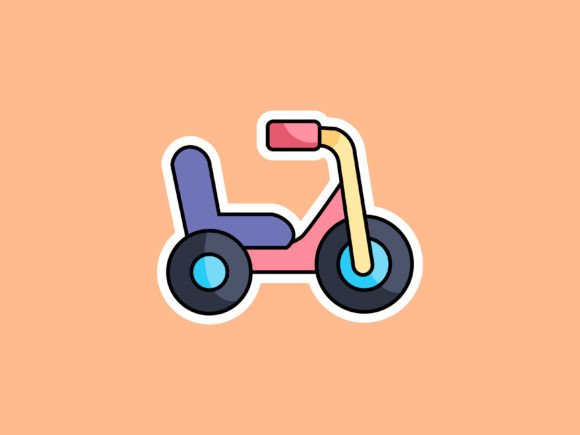
Charming Children Tricycle Illustrations: A Designer's Guide
When you think of childhood nostalgia, few images are as universally comforting as a classic tricycle. That sense of first freedom, the wobbly adventures on the sidewalk, and the bright colors of a sunny afternoon are exactly what Children Tricycle Illustrations capture. This isn’t just a set of graphics; it is a comprehensive design asset collection that bridges the gap between whimsical storytelling and professional utility. Whether you are a graphic designer working on a publishing project or a small business owner looking to brand your Easter merchandise, these illustrations offer a distinct, joyful aesthetic that resonates across generations.
The visual language of this collection is rooted in a friendly, approachable style. You aren’t dealing with overly complex 3D renders or stark minimalism here. Instead, the personality of Children Tricycle Illustrations leans into warmth, featuring soft lines, playful compositions, and a color palette that feels optimistic without being garish. It is the kind of design asset that immediately puts the viewer at ease. The illustrations balance detail with simplicity, ensuring they look professional in print but remain legible and engaging on a small phone screen. This versatility is crucial for modern creatives who need assets that can scale across different media without losing their charm.
Strategic Applications: From Easter Baskets to Brand Identities
The true value of a design asset lies in its adaptability. Children Tricycle Illustrations are particularly potent for seasonal campaigns, especially those centered around Easter. Imagine the imagery of a pastel-colored tricycle adorned with a basket of eggs—it is an immediate visual shorthand for spring, renewal, and childhood joy. However, limiting these designs to a single holiday would be a mistake. They are equally effective for year-round projects in the educational sector. If you are involved in book design, specifically children's book design or notebook design, these illustrations provide the perfect cover art or chapter headers. They add a layer of tactile reality to the reading experience, making the physical product more appealing to both kids and parents.
For the entrepreneur, the application extends heavily into the world of Print on Demand (POD) and merchandise. The market for children’s apparel is competitive, but a well-placed graphic can differentiate a product. Consider using these illustrations for T-shirt prints; the design works well as a central chest graphic or even a pocket print. Because the files are provided in high-resolution formats (300dpi), you don’t have to worry about pixelation when scaling up for pillow covers or totebags. These items require a certain durability in the design to withstand the texture of the fabric, and the bold lines of these illustrations hold up beautifully against cotton or canvas weaves.
Furthermore, the digital landscape is just as hungry for this kind of content. Phone cases are a massive market, and parents often look for cases that reflect their current life stage—raising young children. A cute tricycle illustration offers a subtle, stylish nod to parenthood without being overly sentimental. It fits perfectly into the "modern parent" aesthetic. Additionally, social media managers and content creators can leverage these assets for pattern creation. By repeating the illustration, you can create seamless backgrounds for Instagram stories, blog headers, or website banners that maintain a cohesive visual identity. It serves as a fantastic tool for printed paper goods, such as stationery sets, wrapping paper, and planners, turning a mundane office supply into a charming gift item.
Integrating Illustrations into Professional Design Workflows
For the professional designer, the inclusion of vector formats like AI and EPS is non-negotiable, and this collection delivers exactly that. When you download the Children Tricycle Illustrations package, you are getting the raw ingredients needed for high-end brand identity work. Vectors allow you to deconstruct the artwork. Perhaps you love the wheel of the tricycle but want to use it as a standalone icon for a logo? Or maybe you need to change the color palette to match a client’s specific hex codes? The AI and EPS files give you that control. This flexibility is what separates amateur design from professional execution.
When evaluating how these illustrations fit into a project, consider the visual hierarchy. In packaging design, for instance, the illustration shouldn't just be a sticker slapped on the box. It needs to interact with the typography. If you are pairing these illustrations with a script font or a handwritten font, ensure the line weight of the text complements the stroke weight of the illustration. A common mistake is pairing a delicate, thin serif font with a thick, bold illustration, which creates visual dissonance. Instead, opt for a rounded sans serif font to maintain that friendly, approachable vibe established by the tricycle graphics.
Consistency is another key factor. If you are building a brand identity for a daycare, a pediatric clinic, or a toy store, you need assets that can be used everywhere—from the website to the invoice. Using Children Tricycle Illustrations across your web design elements, your email signatures, and your physical signage creates a unified experience. It signals to the customer that you pay attention to details and that your brand has a cohesive personality. This is where the JPG and PNG files come in handy for quick turnarounds. The transparent PNGs are particularly useful for layering over photographs or colored backgrounds in editorial design or social media graphics without the hassle of masking.
Practical Considerations for File Usage and Licensing
Before integrating any asset into a commercial project, understanding the deliverables is essential. The package includes an AI format (Adobe Illustrator), an EPS format (Encapsulated PostScript), a JPG format, and a PNG format, all at 300dpi. This resolution is the industry standard for print. It ensures that whether you are printing a massive banner or a small sticker, the image remains crisp. The 300dpi specification is particularly vital for the printed paper and book markets, where clarity is synonymous with quality.
When testing these assets for your specific needs, I recommend a "stress test." Open the file in your preferred software—whether that is Photoshop, Illustrator, or even Canva—and see how it behaves. Does the PNG transparency work cleanly over a dark background? Does the vector scale up to the size of a tote bag without losing its charm? For phone case designs, check how the illustration interacts with the camera cutout and the curved edges of the mockup. These practical checks ensure that you aren't just buying a pretty picture, but a reliable design asset that saves you time in the production phase.
Ultimately, Children Tricycle Illustrations are more than just clip art. They are a versatile toolkit for anyone operating in the children's market, the education sector, or the lifestyle branding space. They offer a blend of nostalgia and modern typography compatibility that is hard to find. Whether you are crafting a heartwarming children's book, launching a spring clothing line, or designing a cheerful website, these illustrations provide the visual foundation needed to connect with your audience on an emotional level. They remind us of the simple joy of riding a bike, and in the world of design, connecting with that kind of emotion is the ultimate goal.